
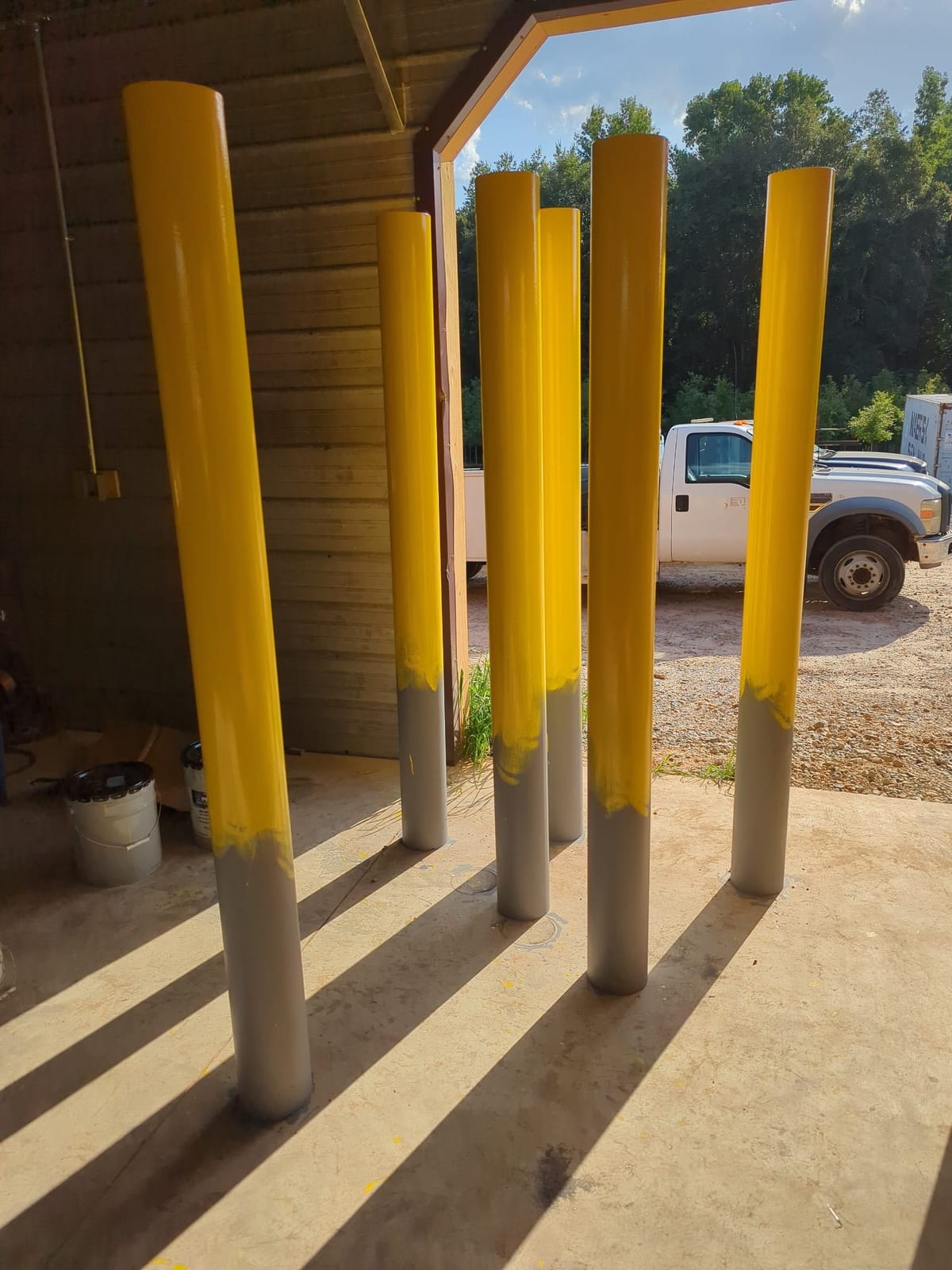
Steel pipe bollards.
Schedule 40 pipe, cut to your height, capped with quarter-inch plate and finished in safety yellow. The thing you put between a truck and whatever you cannot afford to have hit.
- ASTM A53 Gr. B, Schedule 40
- Shop primer + safety yellow enamel
- 1–2 weeks, typical
- Free · Senoia, GA
What it is.
A short answer for the property manager, the site super, and whoever has to sign off on the number.
A bollard is a steel pipe standing in concrete. That is the whole idea, and its simplicity is the point: there is nothing to adjust, nothing to maintain, and nothing that stops working after a winter. Its job is to take a hit that would otherwise land on a building corner, a gas meter, an overhead door jamb, a transformer, a storefront window, or a person.
Ours are Schedule 40 pipe to ASTM A53 Grade B — the same pipe spec that carries steam and water, which means the wall is heavy and consistent rather than the thin-wall tube that gets sold as a bollard sleeve. We cut it to your height, weld a quarter-inch plate cap flush across the top so water cannot stand in the pipe, prime it overall, and put two coats of safety yellow enamel on everything that will be above grade. The buried length stays in primer, which is what the photograph above is showing: yellow to the grade line, grey below it. Topcoat on the embed would only get scrubbed off by the concrete.
Three ways to buy the same bollard. Embed style comes loose for setting in a new or cored footing, which is the strong way to do it. Baseplate style arrives on a half-inch plate with four anchors, for a slab that is already poured and must not be cut. Or our crew sets them: supplied and installed on Georgia jobs, which we quote against the site rather than sell online, because what is under a slab is not something to guess about.
Specifications.
Pipe weights are the published ASTM A53 Schedule 40 values, so your engineer can check them against the standard rather than against us.
| Pipe | Schedule 40 to ASTM A53 Grade B · 4", 6" or 8" nominal |
|---|---|
| 4" nominal | 4.500" OD · 0.237" wall · 10.79 lb/ft |
| 6" nominal | 6.625" OD · 0.280" wall · 18.97 lb/ft |
| 8" nominal | 8.625" OD · 0.322" wall · 28.55 lb/ft |
| Cap | ¼" plate, cut round and welded flush across the top · no standing water in the pipe |
| Height | 24" to 72" above grade, your call · 42" is the usual commercial height |
| Embed | 18" to 48" · 36" default, in an Ø18" footing poured 6" below the pipe |
| Baseplate | ½" plate, square, 4½" larger than the pipe OD (9" / 11" / 13") · (4) Ø⅝" holes · (4) ½" HDG wedge anchors supplied |
| Finish | Shop primer overall, (2) coats safety yellow enamel above grade · embed left primed |
| Concrete fill | Exposed length filled and domed under the cap · included on installed bollards |
| Weight | ≈ 126 lb per 6" embed bollard at 42" + 36" · ≈ 86 lb per 6" baseplate bollard at 42" |
| Not rated | Protective bollards, not vehicle barriers. No ASTM F2656 M rating, no K rating, not crash-tested |
| Made in | Senoia, Georgia · AISC-certified shop |
How it goes in.
The sequence our crew uses, and the one we would hand a site super setting them himself.
Locate and check below
Mark centres and call 811 before anything turns. Bollards go exactly where vehicles already scrape, which is exactly where meters, conduit and irrigation tend to run. On a slab, confirm you are clear of post-tensioning before coring.
Core or dig the footing
An 18-inch hole, 6 inches deeper than the pipe, on undisturbed soil. Baseplate style skips this step entirely — clean the slab, mark the four holes, and drill for the wedge anchors.
Set plumb and brace
Two levels at ninety degrees, then brace it and leave it braced. A bollard 2 degrees out of plumb is visible from across a parking lot forever, and there is no adjusting it once the footing sets.
Pour, fill, patch
Footing first, then fill the pipe once it has taken its initial set, doming the top of the fill so water runs off under the cap. Patch the slab back, and touch up any yellow the shovels found.
Questions we get asked.
From property managers, site supers and the occasional insurance adjuster. If yours isn't here, it goes in the form below.
What size bollard do I need?
How deep does a bollard go in the ground?
Embedded or baseplate — which should I use?
Should a bollard be filled with concrete?
Are these crash-rated or security bollards?
Why painted instead of galvanized?
What is the lead time, and do you ship or install?
Tell us what you're protecting.
A count, a size and what it is guarding is enough to start. We reply the same business day with pricing, lead time and, for Georgia jobs, an installed number.
Got it.
Your request is in the shop's inbox. We'll reply the same business day with pricing and lead time. If it's urgent, call (404) 680-5396.